
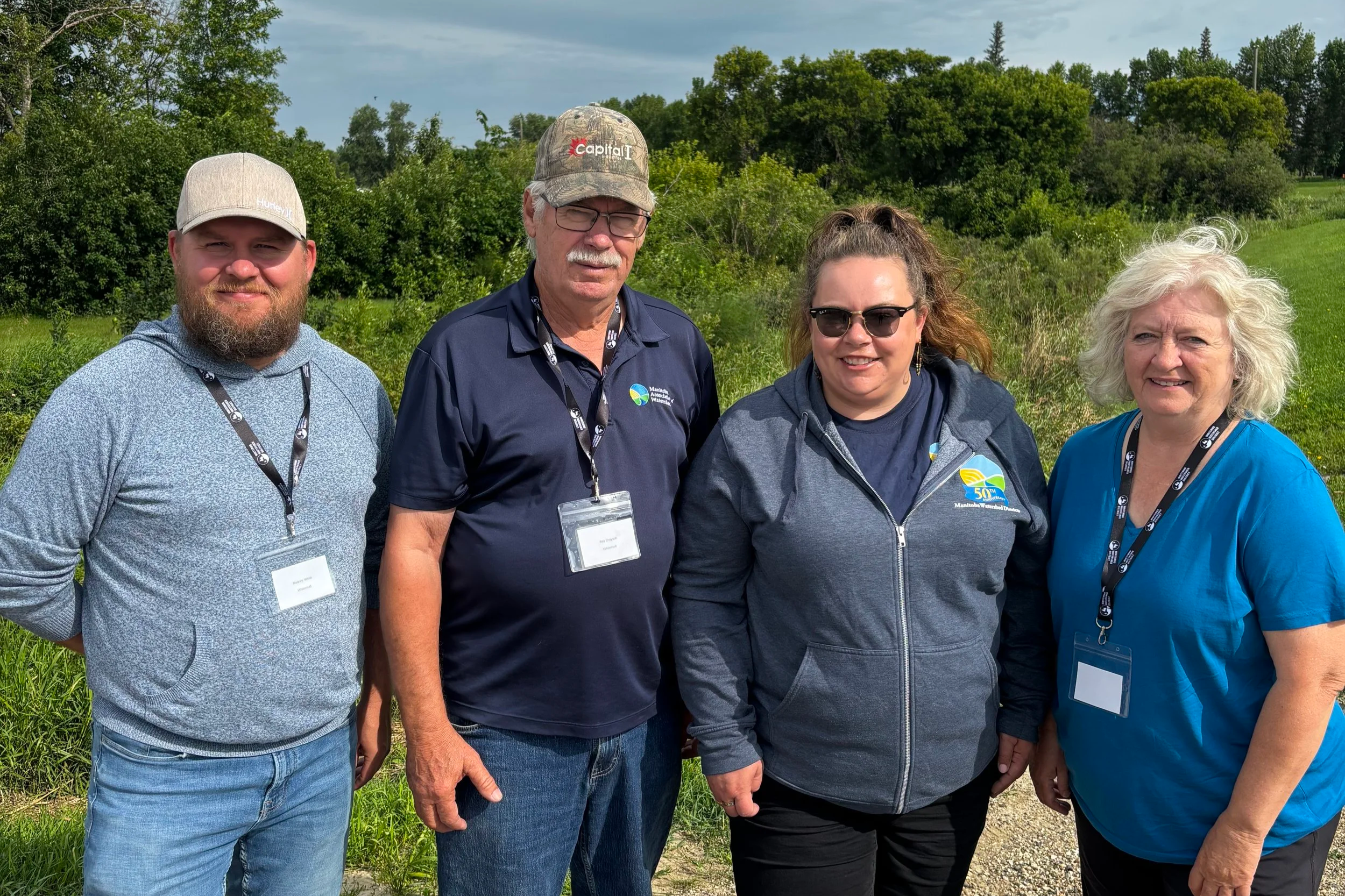
2026 MAW Tour In Neepawa With Whitemud Watershed District
The Manitoba Association of Watersheds recently wrapped up a two-day tour with Whitemud Watershed District, bringing together local leaders and watershed staff to see first-hand the projects shaping water management across the district.
Whitemud Watershed District, headquartered in Neepawa, was established in 1972 as Manitoba's very first conservation district. The district spans roughly 7,115 square kilometres between Riding Mountain National Park, Spruce Woods Provincial Park, and the southern basin of Lake Manitoba, and takes in a number of member municipalities across south central Manitoba. Alongside maintaining more than 1,760 kilometres of drains and associated crossings, the district delivers programming in surface water management, soil conservation, pasture management, groundwater protection, wildlife habitat protection, and environmental education, much of which was on full display throughout the tour.
Day One: From Demonstration Farm to Bank Stabilization….
The tour began at Rosedale Farm, where participants learned how practices developed on the demonstration farm helped shape watershed program delivery after management of the site was passed to Whitemud in 1977. Nearly fifty years later, the farm remains a touchstone for how hands-on work on the ground can influence programming across the district.
From there, the group travelled to Atkinson Farm, home to a 2023 GROW project that supported improved grazing practices through cross-fencing and energy-free thermosinks for livestock watering.
The tour stopped at Grass River Colony, which has been an active participant in nitrogen management programs, and finished the day at the Arden Bank Stabilization project. Established in 2024 with support from the Municipality of Glenella-Lansdowne, the project addressed erosion along the Whitemud River that was putting the campground access road at risk.
Day Two: Infrastructure, Storage, and Long-Term Planning….
Day two took the group to project sites across the district, including the Deadlake Drain, the RD 74 Bridge, the Manitoba Agricultural Museum, and the RD 71 Water Storage project. Each stop offered a different angle on watershed management, from moving and storing water to repairing infrastructure.
The focus was protecting community infrastructure, supporting agricultural land, or monitoring water over time, the projects on display reflected the kind of long-term planning and collaboration that watershed work depends on.
The power of Collaboration at the Centre of It All…..
Across both days, one theme carried through every stop: collaboration. Municipalities, producers, watershed districts, and provincial programs, the work being done throughout Whitemud Watershed District is the product of many groups pulling in the same direction.
As a sponsor of the tour, MAW is proud to support these regional gatherings. Bringing local leaders and watershed staff together to share knowledge and build strong relationships to further advancing water management and water programming across Manitoba.
Thank you to everyone who attended, and a special thank you to Whitemud Watershed District for hosting this year's tour and sharing the history, partnerships, and collaboration behind these projects.